How can we help you?
Tell us what you are looking for
What is a market order?
A market order is the fastest way to buy or sell an asset. When you place it, your order is executed immediately at the best available market prices.
How does it work?
When you place a market buy order, it is matched with the best available selling price on the market (the *ask price*). Conversely, a market sell order is executed at the best available buying price (the *bid price*). The difference between these two prices is called the *spread*.
Advantages:
- Fast Execution. Your order is filled almost instantly, provided there is sufficient liquidity.
- Simplicity. No need to set a specific price. It's ideal when your priority is fast execution and the market is liquid.
Risks and Important Considerations:
- Lack of Control over the Execution Price. During fast market movements or low liquidity, the final price at which your order is executed may differ from the price displayed at the moment of placing it. Volatility can lead to price *slippage*.
- Impact of the Spread. When buying, you will pay the *ask* price, which is typically slightly higher than the last quoted market price. When selling, you will receive the *bid* price, which is slightly lower.
How to submit a Market Order in EFOCS?
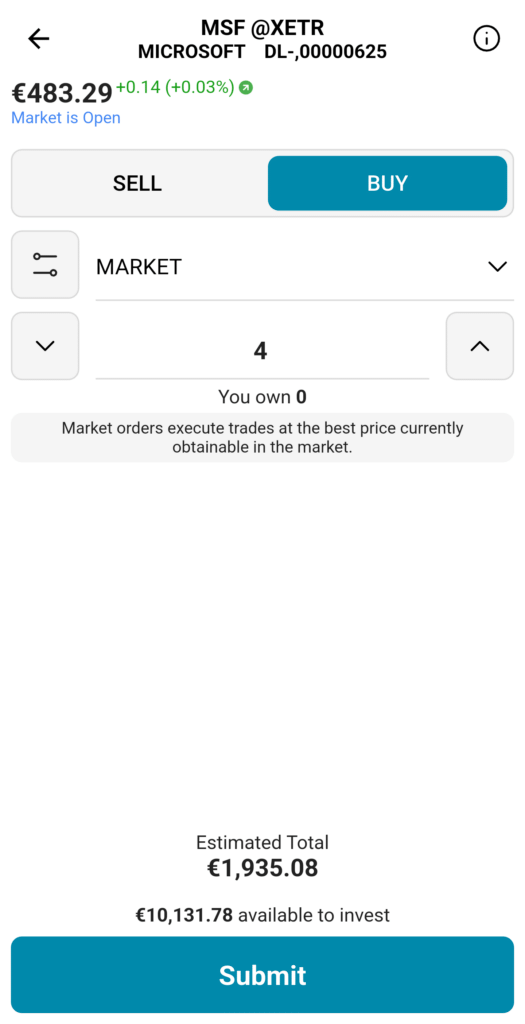
- Select the order type. From the dropdown menu select "MARKET".
- Enter quantity. In the quantity field, specify the number of shares, units or face value (for bonds) that you wish to buy or sell. The application will display the "Estimated Total" of your order, calculated using the current best available ask price for buy orders and the current best available bid price for sell orders.
- Submit the order. Click on the “Submit” button. Remember, the execution price may differ from the one you last saw on your screen.
- Execution and confirmation. Your order will be sent for immediate execution and will be filled at the available market prices within seconds, after which you will receive a confirmation.
Tip: Use market orders when speed is critical and the asset is highly liquid (e.g., large-cap stocks or major ETFs). For greater control over the execution price, consider using Limit orders.